
Bachelor of Engineering (Hons)
Electrical Engineering
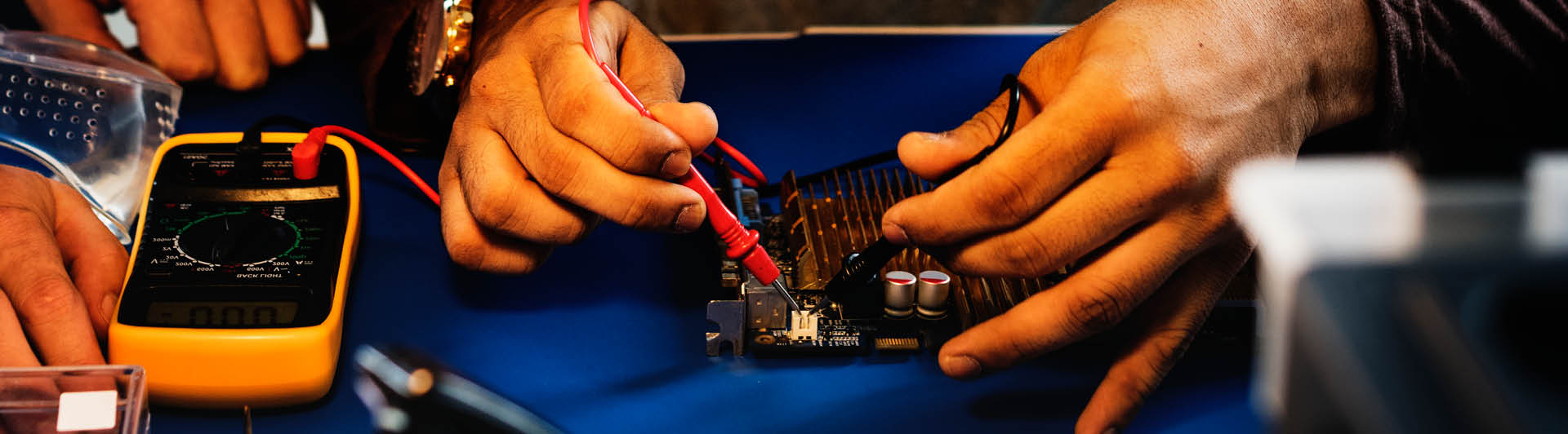
The Bachelor of Engineering Honors Electrical program gives students the opportunity to get hands-on with a range of advanced technologies - including automated test equipment, embedded real-time controllers, sensors, and the Internet of Things. As an electrical engineering professional students get to focus on interpreting requirements and designing and implanting engineering solutions which optimize social, environmental, and economic sustainable outcomes over the full lifetime of the engineering product or project.
Duration
Schedule
Location
- MALABE CAMPUS
- * Start at SLIIT and transfer abroad to finish your degree.
SLQF Level
Medium
Awarding University
This internationally recognized academic programme is awarded by the University of Queensland.
Ensures globally accepted academic standards, preparing students with practical skills aligned to current industry needs and expectations.

Accreditation



_1762236795.png)
Why & What..?
Choosing the University of Queensland (UQ) Electrical Engineering degree at SLIIT offers students a unique opportunity to gain a world-class engineering education while beginning their studies in Sri Lanka. This 2+2 pathway program allows students to complete the first two years at SLIIT and transfer to UQ—ranked among the top 50 universities globally and a member of Australia’s prestigious Group of Eight.
The program provides a strong foundation in electrical circuits, electronics, signal processing, control systems, and power engineering, with a focus on real-world applications and innovation. Students benefit from hands-on labs, project-based learning, and exposure to cutting-edge technologies that prepare them for the demands of modern electrical engineering careers.
UQ’s Bachelor of Engineering (Honours) is accredited by Engineers Australia and recognized under the Washington Accord, enabling graduates to work as professional engineers in over 20 countries. This global recognition opens doors to careers in renewable energy, telecommunications, robotics, embedded systems, and smart infrastructure.
The program also emphasizes sustainability, ethical engineering, and leadership, ensuring graduates are not only technically skilled but also socially responsible. With access to UQ’s world-class research facilities and industry partnerships, students gain valuable experience and networking opportunities that enhance their employability.
In short, the SLIIT–UQ Electrical Engineering degree combines academic excellence, international recognition, and practical experience, making it an ideal choice for students aiming to power the future of technology.
Graduates of the University of Queensland (UQ) Electrical Engineering degree are equipped with the knowledge, skills, and global recognition needed to thrive in a rapidly evolving technological world. The program is designed to produce engineers who are not only technically proficient but also innovative, ethical, and industry-ready.
Students develop a deep understanding of electrical systems, electronics, signal processing, control systems, embedded systems, and power engineering. They gain hands-on experience through labs, simulations, and real-world projects, enabling them to design, analyze, and implement complex electrical and electronic systems.
The program emphasizes problem-solving, critical thinking, and systems-level design, preparing graduates to tackle challenges in areas such as renewable energy, smart grids, robotics, telecommunications, and automation. Students also learn to use industry-standard tools and software, enhancing their technical fluency and adaptability.
Graduates are trained to work effectively in multidisciplinary teams, communicate technical ideas clearly, and manage engineering projects with a focus on sustainability and societal impact. The program’s accreditation by Engineers Australia and recognition under the Washington Accord ensures that graduates are eligible for professional engineering roles in over 20 countries.
By the end of the program, students are not only ready for employment but also well-prepared for further study, research, or entrepreneurship in the field of electrical engineering. The SLIIT–UQ pathway offers a powerful combination of local accessibility and international excellence, making it a launchpad for a successful global engineering career.
-


Programme Structure
-
First Year
Students will learn foundation in mathematics, physics, electrical circuits, digital systems, and programming with practical labs and design projects.
-
Second Year
Students focus on electronics, signal processing, control systems, electromagnetics, and embedded systems with advanced lab work
| Semester 1 | ||
|---|---|---|
| Code | Module | Credit |
| CE1020 | Statics and Hydrostatics | 3 |
| EC1022 | Electrical Systems | 3 |
| MA1111 | Engineering Mathematics I | 4 |
| ME1050 | Introduction to Engineering Design and Communication | 4 |
| EL1203 | English Language Skills I | 3 |
| CE1913 I | ntroduction to Sustainable Engineering | 2 |
| Semester 2 | ||
|---|---|---|
| Code | Module | Credit |
| ME1060 | Dynamics | 3 |
| EC1450 | Fundamentals of Programming | 3 |
| MA1121 | Engineering Mathematics II | 4 |
| MT1011 | Engineering Materials | 4 |
| ME1031 | Engineering Skills Development | 3 |
| EL1213 | English Language Skills II | 2 |
| Semester 1 | ||
|---|---|---|
| Code | Module | Credit |
| ME2820 | Fluid Mechanics and Thermodynamics | 3 |
| EC2093 | Foundations of Digital Design | 3 |
| EC2203 | Electrical Circuits | 3 |
| EC2493 | Object Oriented Programming | 3 |
| EC2132 | Microcomputers | 3 |
| MA2111 | Engineering Mathematics III | 3 |
| Semester 2 | ||
|---|---|---|
| Code | Module | Credit |
| EC2140 | Analogue Electronics | 3 |
| EC2113 | Signals and Systems | 3 |
| EC2220 | Electrical Machines and Power Systems | 3 |
| EC2731 | Data Structures and Algorithms | 3 |
| EC2403 | Computer Networks | 3 |
| MA2121 | Engineering Mathematics IV | 3 |
| - | Humanities I | 2 |
| EC2922 | Industrial Training I | 3 |
More about the program
Minimum of 2 “C” passes and 1 “S” pass in G.C.E A/L (Local) in the Physical Science Stream (Covering Combined Mathematics, Physics & Chemistry) in one and same sitting OR 2 “B” passes and 1 “C” pass in Cambridge or Edexcel A/Ls in the Physical Science Stream (Covering Mathematics, Physics, Chemistry) in one and same sitting AND Successful completion of the SLIIT International Foundation Program Pass the Aptitude test conducted by SLIIT.
Applicant should maintain minimum GPA of 2.5 to transfer.
The fee is presently Rs.610,000/- per semester. Fees for any subsequent semester should be paid prior to the commencement of each semester. This all-inclusive fee is charged to cover lectures, tutorials and examinations and access to computer laboratory facilities and library.
The fees should be credited to, Account No 1630552 of the Bank of Ceylon in favour of Sri Lanka Institute of Information Technology, at the Bank of Ceylon Kollupitiya Branch located at the first floor of the BoC Merchant Tower Building or at any branch of the Bank of Ceylon; or to Account No 00 399 0000033 of the Sampath Bank at any branch of Sampath Bank. Normally, fees paid will not be refunded. However, requests for refund of fees may be considered if made before expiry of one week from the date of commencement of lectures for each semester. The date of commencement of lectures for the new applicants will be the date of commencement of lectures of the Orientation Programme. The refund, if made will be subject to a deduction of ten percent of the fee paid.
20% scholarships are available. Terms and conditions apply.
The Bachelor of Engineering Honors Electrical program gives students the opportunity to get hands-on with a range of advanced technologies - including automated test equipment, embedded real-time controllers, sensors, and the Internet of Things. As an electrical engineering professional students get to focus on interpreting requirements and designing and implanting engineering solutions which optimize social, environmental, and economic sustainable outcomes over the full lifetime of the engineering product or project.
FAQs
The program follows a 2+2 model, where students complete the first two years at SLIIT and transfer to the University of Queensland (UQ) in Australia for the final two years. Graduates receive a Bachelor of Engineering (Honours) in Electrical Engineering from UQ.
Yes. The degree is accredited by Engineers Australia and recognized under the Washington Accord, allowing graduates to work as professional engineers in over 20 countries, including the UK, USA, Canada, and Japan.
Yes. Students are required to do an English proficiency test such as IELTS, TOFEL or PTE.
Graduates can pursue careers in power systems, telecommunications, robotics, embedded systems, automation, and renewable energy. They are well-prepared for roles in both the public and private sectors, locally and internationally.